
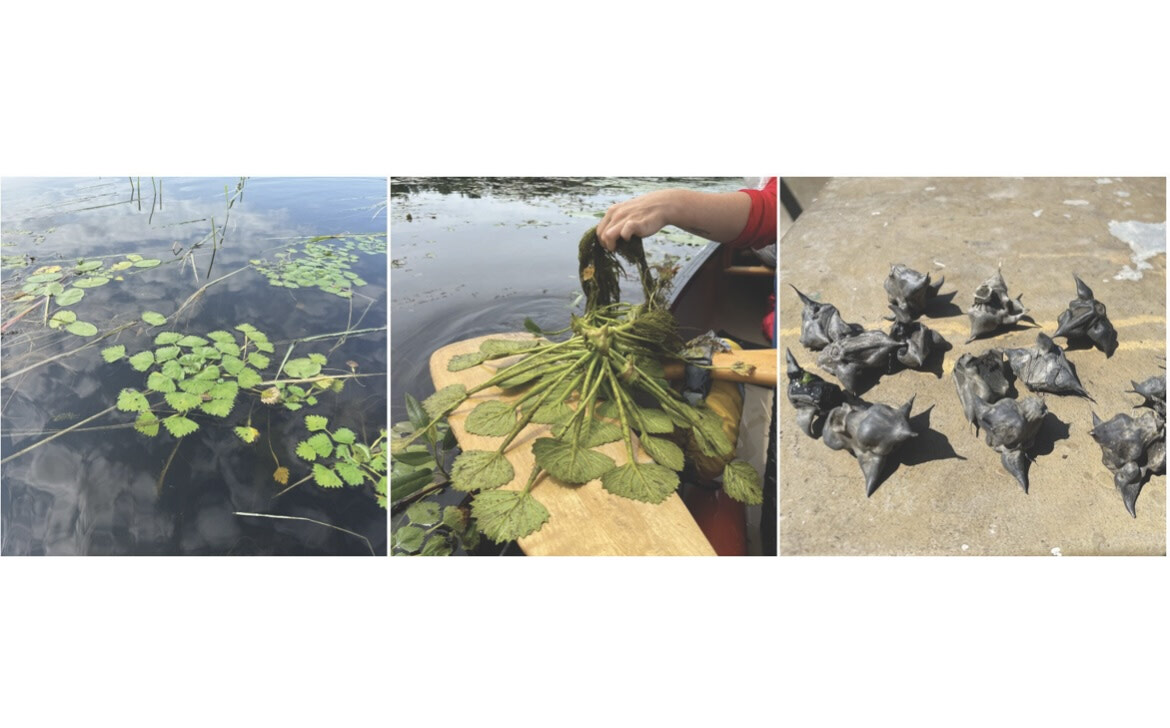
Water chestnut is in steep decline in Lochaber Bay after three summers of hand-pulling by COBALI and its partners, but the group warns that seeds can lie dormant for years and is urging boaters to clean their boats so the plant doesn’t spread. Photo: Mark Gloutney - Muskies Canada
Water chestnut losing ground in Lochaber Bay, but boaters urged to stay alert
Tashi Farmilo
Water chestnut, an invasive plant that had taken over large parts of Lochaber Bay on the Ottawa River, is in steep decline after three summers of removal work led by the Lièvre River watershed committee. Crews pulled 436 kilograms of the plant from the bay this year, less than a fifth of what they removed in 2024, as they work to wipe it out before it reaches other waters.
The bay lies on Gatineau’s eastern edge, and its waters are shared by the city’s Masson-Angers sector and the Township of Lochaber-Partie-Ouest. The committee, known by its French acronym COBALI, confirmed the plant there in 2023.
“The work is going better and better, but it’s important to stay vigilant,” Marie Lagrandeur, a project manager with COBALI, said.
The plant lives for only one season, so the plan is simple: pull it out before it can set seed. “Because it’s an annual plant, if the plants are pulled before they produce nuts, eradication is possible,” Lagrandeur said. The hard part is what is already on the bottom. Quebec’s environment ministry says one plant can sprout as many as 15 rosettes, each able to produce 15 nuts, and those nuts can stay dormant in the sediment for years. Skipping a single summer could wipe out much of the progress.
The plant is easy to spot, with triangular, saw-edged leaves floating on the surface in a circular cluster. Its fruit is a hard, horned nut with points sharp enough to cut a bare foot. It is a different species from the water chestnut sold in cans for stir-fries.
Where it takes hold, it forms a dense floating mat. Fish and other aquatic animals underneath have less oxygen, and native plants lose the nutrients they need, until little else can survive. “Navigation is practically impossible in heavily affected areas,” Lagrandeur said.
At Lochaber, a lot is at stake. COBALI calls the bay “a natural jewel on the Ottawa River.” Its wetlands support at-risk species such as the least bittern, the bald eagle and the northern map turtle, and the bay is within the boundaries of the planned Grandes-Baies-de-l’Outaouais wildlife refuge.
Lagrandeur said the plant is also growing on the Ontario side, in the Rideau Canal and Clarence Creek. It travels mostly by boat, with stems wrapped around propellers that ride along to the next launch. COBALI also suspects the barbed nuts can catch in the feathers and fur of waterfowl and other animals.
More than a dozen organizations have taken part in the work at Lochaber, including the City of Gatineau, Sépaq’s Parc national de Plaisance, Ottawa Riverkeeper, the Kitigan Zibi Anishinabeg community and the MRC de Papineau. The effort started as a three-year project funded by the Fondation de la faune du Québec, and Lagrandeur said it will continue in 2027 if new funding comes through.
The campaign is part of a broader water protection awareness program that COBALI has run for 21 years, funded by Énergie Brookfield since the start. Founded in 2003, the non-profit is one of 40 watershed organizations recognized by Quebec, and its territory covers about 30 municipalities, including Gatineau’s Buckingham and Masson-Angers sectors.
In Quebec, residents who find the plant can report it with a photo through the province’s Sentinelle app or website, or tell their municipality or COBALI. Ontario sightings go to the province’s Invading Species Hotline at 1-800-563-7711. “Early detection of invasive species leads to more successful control,” Lagrandeur said.
For boaters, the precautions are straightforward: pressure-wash the boat when moving from one body of water to another, check the motor for plants caught on it, find out which invasive species are in the water before launching, and stay away from infested areas. Lagrandeur noted that the Ottawa River already has several invasive plants and animals, and she asked residents heading north to cottage country to take extra care. “Cleaning boats,” she said, “is essential.”
Anyone interested in volunteering can contact COBALI at info@cobali.org.