
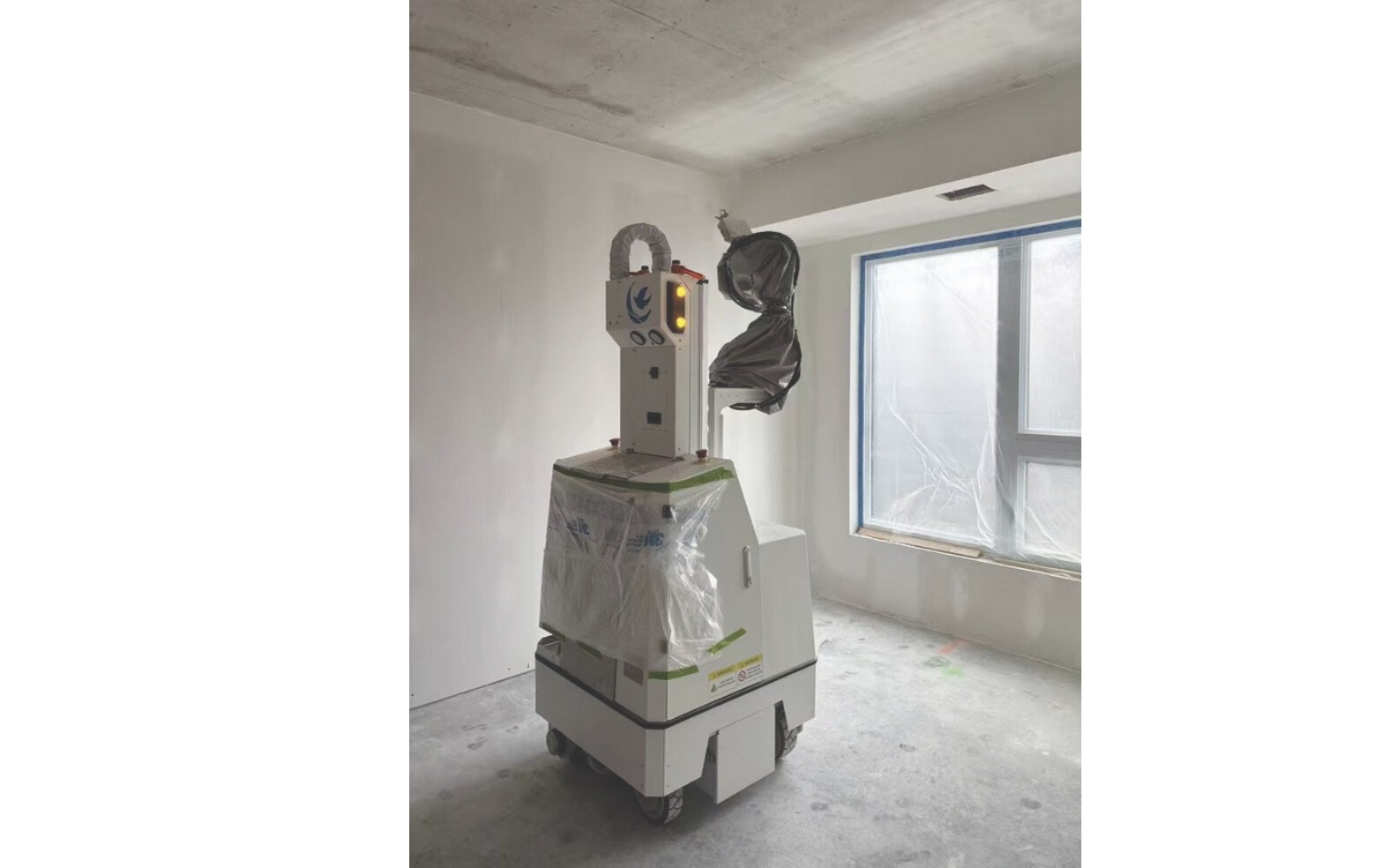
Shenzhen manufacturer Legend Robot has named Gatineau’s CD Peintre its regional agent and plans to bring five to 10 more autonomous painting robots to the region in the coming months. The machines will be run by CCQ-certified painters, and both companies present them as an answer to the industry’s shortage of skilled labour. Photo: Jason Liang
Labour shortage solution: robots
Painting robots head for Gatineau job sites, with tradespeople at the controls
Tashi Farmilo
Autonomous painting robots will begin arriving on Gatineau construction sites in the coming months, under a partnership announced November 12 between Shenzhen manufacturer Legend Robot and Gatineau contractor CD Peintre that both companies present as an answer to the industry’s shortage of skilled painters.
Legend Robot ran its first local trial in Ottawa, inside a residential building at 18 Louisa St., near Little Italy. According to the company, its 3.3-metre spraying robot coated interior walls and ceilings there at 221 square metres an hour and laid down 15 litres of undiluted latex without a single sag or run. CD Peintre held the painting contract, and BurMont Construction was the general contractor.
“Our current operations began on the Ottawa side with a residential project,” Jason Liang, Legend Robot’s marketing director, told the West Quebec Post. “This first phase is the starting point of a gradual expansion across the entire National Capital Region, including the Outaouais, Gatineau, Hull and Aylmer, in the coming months. We are starting with the residential sector and plan to expand into commercial and industrial projects as our deployment progresses.”
The fleet will grow at a measured pace. “A first unit is already operational in the field,” Liang said, “and we plan to gradually deploy between five and 10 additional robots on job sites in the region in the short and medium term.”
The robots will start in housing while Quebec is building at a historic pace. The province broke ground on 43,506 rental units in 2025, 22 per cent above the previous record set in 2021. Gatineau’s housing department counted about 1,300 subsidized social and non-market units under construction or planned as of September 2025, a total it described as a record.
Painting with a robot begins with surveying rather than masking. Technicians scan each room in three dimensions, position the machine and refine the routes it will travel before it sets off on its own. The company’s larger 6.2-metre commercial models, unveiled this year at the CONEXPO trade show in Las Vegas, take the idea further: they use real-time 3D sensing to spray continuously while in motion.
The company reports that the Ottawa work met Level 4, the second-highest grade on the Gypsum Association’s scale of zero to five and the usual benchmark for homes finished in flat paint. That is the everyday residential standard, which is exactly the market Legend Robot is going after. The company says the robot also accepts Sherwin-Williams, PPG and Benjamin Moore paints without modification, so contractors can keep using the products architects already specify.
CD Peintre gives the venture its local credentials. The family firm was founded in Gatineau in 2005 and is led by president and chief executive Miguel Massiah and general manager Marco Massiah. It has built its name on commercial, industrial and institutional painting in the Outaouais and Ontario. The Association de la construction du Québec named it construction company of the year for the Outaouais, Abitibi and Nord-Ouest region at its Prix Construire gala, held in Gatineau in May 2025.
“In the region, we work closely with our partner and distributor CD Peintre, which handles integration in the field,” Liang said. Contractors that adopt the robots get free on-site training on safety, startup and daily maintenance, and technicians to help with scanning, setup and troubleshooting. They also receive manuals adapted for local use and service scheduled around Canadian job-site timelines and safety codes.
Liang struck a broader note in the company’s announcement. “We are thrilled to partner with CD Peintre as North America embraces robotic construction,” he said. “This collaboration allows us to empower local jobsites with cutting-edge automation, driving efficiency and industry modernization.”
Quebec will test the technology in ways no trade show can. The announcement cited standards from OSHA, the American workplace safety regulator, which has no authority in Canada. “Although our press release mentions OSHA standards as a North American reference, our equipment is designed to meet the strictest safety standards, including all CNESST requirements in Quebec,” Liang said, referring to the province’s workplace health and safety board.
Who operates the machine is just as important. Quebec requires anyone painting on a construction site to hold a competency certificate from the Commission de la construction du Québec. “On Quebec job sites, we work closely with CD Peintre and partner contractors to fully comply with the regulations of the Commission de la construction du Québec,” Liang said. “Our robots are designed as assistance tools intended to be operated by qualified painters holding their CCQ competency cards, supported by our technical team during commissioning.”
That assurance carries particular weight in a province where the trades are strictly separated. A 2023 study by the Association de la construction du Québec, cited by the Canadian Federation of Independent Business, found that labour productivity in Quebec’s construction sector trails Ontario’s by 13 per cent. The study named training, the separation between trades and limited labour mobility as the main causes. With a certified painter at the controls, a robot could raise output without redrawing the boundaries that decide who may do the work.
The pressure on the workforce is heavy. The CCQ projects that construction will need an average of 17,000 new workers a year through 2030. The painting trade drew 608 new apprentices in 2025, joining the 6,863 painters who worked on Quebec sites that year.
Liang described the robots as help for the people already holding the brushes, not a replacement for them. “Our goal is not to replace painters, but to address the shortage of skilled labour in the construction sector,” he said. “By automating the most repetitive and physically demanding tasks, such as sanding or painting large surfaces at height, our robots improve workers’ health and safety while allowing painters to focus on higher-value finishing work.”