
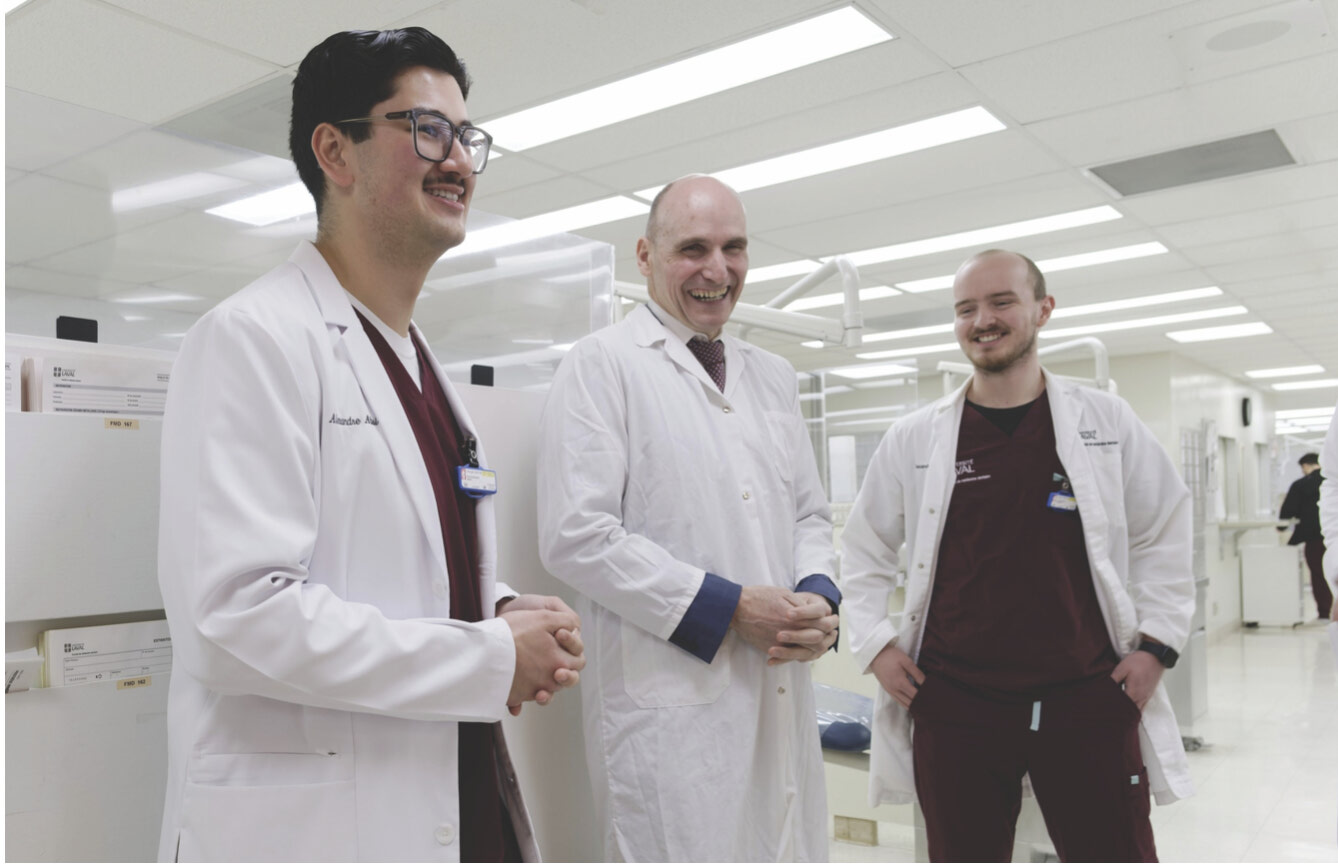
Jean-Yves Duclos, Member of Parliament for Québec-Centre, accompanied by oral health students from Université Laval at the announcement of $3.8 million in funding for the Oral Health Access Fund (OAHF) project (March 31, 2026). Photo: Courtesy of Faculty of Dentistry – Université Laval
New funding for dental care
Mélissa Gélinas
The Government of Canada announced $3.8 million in funding for the Oral Health Access Fund (OAHF) project at Université Laval. This financial assistance will help support and improve the training of students in the Faculty of Dentistry while expanding access to dental care for the population. To xdo this, funding will be distributed for the completion of three projects.
1st project
More than $2.3 million has been awarded to create internships in social dentistry (a public health approach to making oral health care accessible to vulnerable people at a lower cost). These trainings will be offered in a community clinic located in downtown Quebec City and in a new clinic located in the South Shore region of Beauce.
2nd project
Thanks to more than $1 million in funding, oral health care students will now be able to complete part of their training in private practices located in underserved regions of Quebec.
3rd project
More than $450,000 will be allocated to the training of students in oral health care, while maintaining and supporting adherence to the Canadian Dental Care Plan (CDSP) among eligible residents of the Quebec City and Lévis regions.
A much more extensive investment
These projects are part of an overall investment of more than $35 million over three years to support 30 FASB projects in several Canadian provinces, including Quebec, Alberta, British Columbia, Manitoba, New Brunswick, Ontario, Prince Edward Island and Saskatchewan.
About the FASB
The FASB is a grants and contributions program established by Health Canada. Since April 2025, the government has committed to distributing $250 million over a three-year period.
Its objective is to improve oral health care training among students and to expand access to this care for vulnerable populations or living in remote areas, through the support of various projects.
The program also complements the Canadian Dental Care Plan (CDHC), which currently benefits more than 6 million Canadians, including 1.7 million Quebecers who do not have access to private insurance and whose family net income is less than $90,000.