
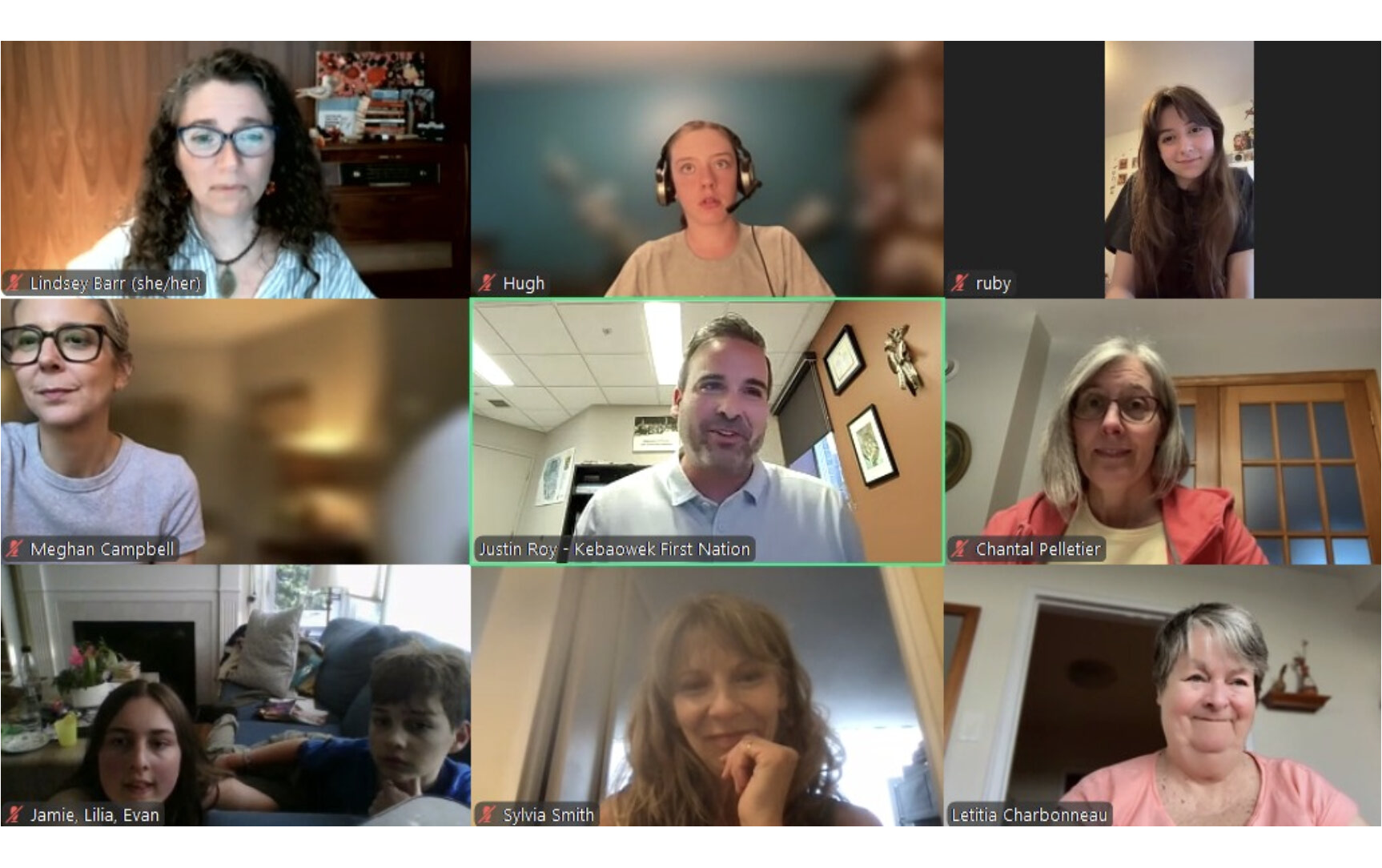
Kebaowek First Nation and the youth group World-Changing Kids held an online public event on May 28, featuring a child-led presentation against the proposed Chalk River nuclear waste facility, as the two groups push a House of Commons petition opposing the project. (TF) Photo: Screenshot of the Kebaowek First Nation and the youth group World-Changing Kids webinar, May 28, 2026.
Kebaowek First Nation and World-Changing Kids enlist youth in Chalk River nuclear waste fight
Tashi Farmilo
Kebaowek First Nation and the youth group World-Changing Kids held a webinar on May 28 built around a presentation researched and delivered by children, aimed at opposing a proposed nuclear waste site near the Ottawa River.
The session focused on the Near Surface Disposal Facility, or NSDF, proposed for the Canadian Nuclear Laboratories site at Chalk River, Ontario, on unceded Algonquin territory about 1.1 kilometres from the river. The young presenters, who call themselves the Upstanders, refer to it plainly as a nuclear waste dump. Their presentation, The Nuclear Waste Dump at Chalk River and Kebaowek First Nation's Fight Against It, was created with Kebaowek councillor Justin Roy.
The event was led by Lindsey Barr, founder of World-Changing Kids, which runs an online social justice program for youth aged roughly 12 to 16. Justin Roy, the First Nation's director of economic development and an elected councillor, offered reflections and took questions. Kebaowek's stated position, which the youth read aloud, is that it is neither for nor against nuclear power but opposes its territory becoming a permanent home for nuclear waste. The group's stated goal is to share the presentation with classrooms across Canada so other students can learn the material and present it themselves.
At the event, Barr said a House of Commons petition the group launched in March with NDP MP Leah Gazan had reached 987 signatures, and that Gazan was scheduled to read it in the House on June 3.
The proposed facility has been the subject of repeated court challenges. The Canadian Nuclear Safety Commission approved it in January 2024. In February 2025, Federal Court Justice Julie Blackhawk found the consultation process inadequate for not properly accounting for the United Nations Declaration on the Rights of Indigenous Peoples, and ordered renewed consultation aimed at an agreement by September 30, 2026. In March 2025, Justice Russel Zinn overturned a separate species at risk permit, finding the proponent had not shown it considered all reasonable alternative sites. Both rulings were appealed, and the Federal Court of Appeal heard arguments last October.