
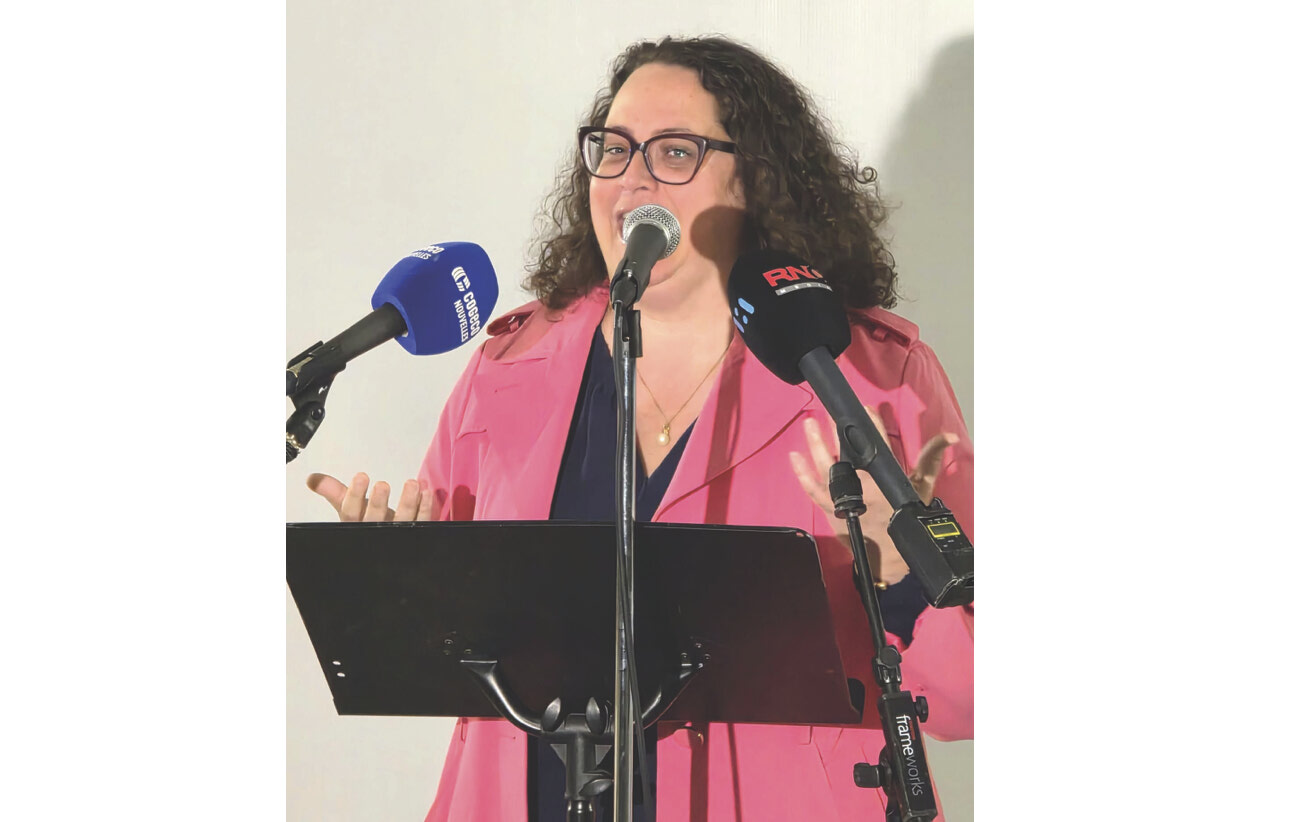
Gatineau councillor Isabelle N. Miron, who has blocked at least 200 Facebook accounts since her re-election, is calling on the public, police and society to curb online hate before it drives elected officials off social media and deters women, young people and minorities from running for office. Photo: Tashi Farmilo
Isabelle N. Miron fears online hate could push women and youth away from politics
Tashi Farmilo
Online hate aimed at elected officials has become so relentless that Isabelle N. Miron, Gatineau councillor for the Orée-du-Parc district, has blocked at least 200 Facebook accounts since her re-election in November 2025. She is now calling on residents, police and society at large to act before local politicians give up on social media altogether.
Miron, who sits with Action Gatineau, was first elected in 2017 and is now in her third term. She serves as deputy mayor, chairs the city's commission on arts, culture, letters and heritage, and is vice-chair of its commission on transportation, sustainable mobility and safety, a role tied to some of the very files that draw the most anger online. In response to the West Quebec Post, she said criticism has always come with public life, but its nature has changed.
"Speaking in public means exposing yourself to criticism, and it has been that way since the beginning of time. What has changed with social media is that it is now dehumanized, anonymous and instantaneous," she said.
The change shows up starkly in her own numbers. "In my first two terms, I blocked maybe two or three people, at most, on my municipal councillor Facebook page. Since my re-election last November, I have blocked at least 200 accounts: a lot of fake accounts, bots, people from outside Gatineau who see my posts because algorithms push content at them specifically to make them angry."
Some of the topics that draw the most fire are the tramway and active transportation, both sore points in the west end. The tramway has stirred strong feelings in Aylmer and Hull since February, when Quebec withdrew its funding and handed the project to Mobilité Infra Québec for review.
For women in public life, Miron said, the attacks tend to take a particular form. "As for women, and every woman will tell you this, whether she is a broadcaster, an artist or a politician, the comments often go beyond a difference of opinion and become personal attacks on physical appearance."
The numbers support her. In a 2024 Léger survey of more than 1,300 Quebec municipal officials, commissioned by the Union des municipalités du Québec, women reported verbal abuse, intimidation and threats at higher rates than their male colleagues. Close to two-thirds of female mayors and councillors said they had faced verbal abuse, and more than half said they had been intimidated or threatened.
Miron traces the decline to the pandemic. "Things have gotten nastier on social media since the pandemic. I'm not the only one saying so."
Gatineau has already seen where that climate can lead. Then-mayor France Bélisle, the first woman elected to lead the city, resigned with immediate effect in February 2024, partway through her term. She spoke of personal attacks that went well beyond political criticism, of death threats from members of the public, and of labels too readily attached to women, and said she was leaving to protect her health. Within a week, Quebec launched a psychological helpline for municipal officials, and that spring it tabled legislation to protect them.
More than two years later, the departures continue. Frampton mayor Gina Cloutier announced her resignation and her exit from municipal politics on October 6, less than a year after taking office and four years after first joining council in the Beauce municipality. In a news release, she said she had personally received insults and threats in recent weeks amid a dispute over renovations to the community hall, and that she was leaving to protect her physical and mental health and her safety.
The problem is not unique to Quebec. A 2025 Canadian Municipal Barometer poll found that 63 per cent of local politicians across the country had experienced some form of harassment, according to an analysis published in July by the Institute for Research on Public Policy. The same researchers found that half of the threats against municipal politicians reported in Canadian news since 2020 were made online.
Miron says the first remedy has to come from the public itself. "It is high time people took responsibility and adopted more cordial behaviour online. You can disagree and say so without resorting to insults, but that is not at all the direction we are heading. It worries me for the future."
She also wants police to change how they treat what happens on a screen. "Police forces also need to treat online threats as 'real' threats," she said. She knows of several cases where victims were not taken seriously enough because the threats came online, though she stressed she was not one of them. "But under the law, threats are a criminal act, whether in person or online."
The legal tools exist. Quebec's 2024 law, adopted unanimously, allows elected officials to seek an injunction from Superior Court against anyone who threatens, intimidates or harasses them, and sets fines of up to $1,500. A Superior Court judge in Longueuil used the law in January to issue a permanent injunction barring a man from attending council meetings after a pattern of threats and harassment toward municipal officials. The Union des municipalités du Québec now offers legal insurance to officials facing harassment and is developing training on online violence.
What Miron does not expect is help from the platforms. "I don't believe it's realistic to expect a platform like Facebook to 'self-regulate,' so it's up to us as a society. Because in the end, local elected officials will simply stop having Facebook pages, and that would be a shame for exchanges with citizens."
For Miron, the stakes reach beyond her own page to the question of who will be willing to sit at the council table in the years ahead. "I'm speaking out to make people a little more careful about what they write. We want to recruit women, young people and people from minority communities into decision-making bodies, but in the current climate, we are not making it easy for ourselves!"