
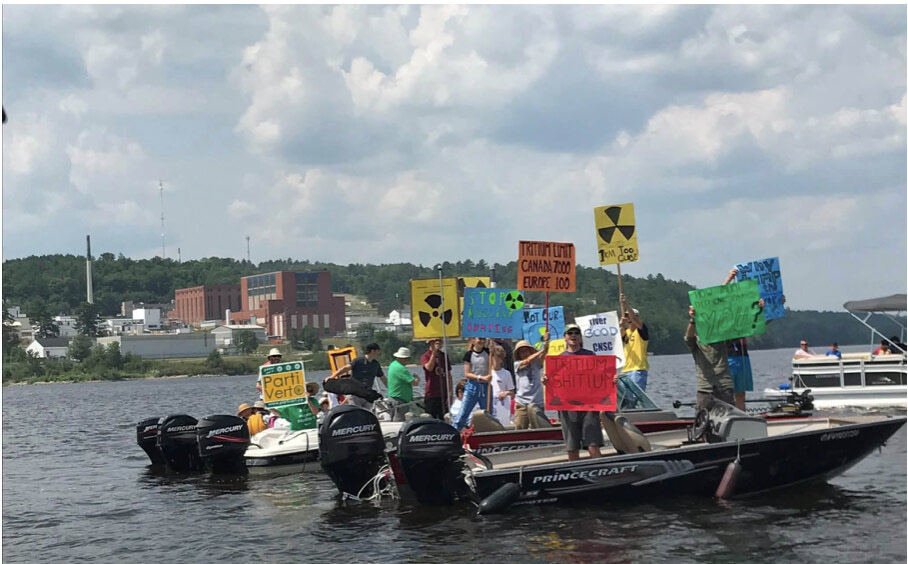
A public forum in Gatineau on September 26 will bring Algonquin leaders, a scientist and local residents together to examine the contested plan to bury radioactive waste at Chalk River, upstream on the Ottawa River, a project the courts have already sent back to the federal government twice. Photo: Courtesy of École d'été citoyenne
Gatineau forum to examine the Chalk River radioactive waste plan
Tashi Farmilo
A public forum gathering Algonquin leaders, a scientist and Outaouais residents to examine plans for a radioactive waste site upstream at Chalk River will be held in Gatineau on September 26. Free and bilingual, the gathering at the Centre communautaire Tétreau, in Parc Moussette, is organized by the École d'été citoyenne at the Université du Québec en Outaouais and the community initiative LabPop, which settled on nuclear power this year as the regional question residents most wanted to understand.
The day opens at 11 am with an Indigenous water ceremony led by researcher and community organizer Dara Wawatie-Chabot, held by the river, alongside an art exhibit created with the Kitigan Zibi and Kebaowek First Nations. A free lunch follows at noon. From 1 to 3 pm, a panel turns to the substance: the history of the Chalk River laboratories, the proposal to bury radioactive waste beside the river, the court challenges it has met, and the standing of First Nations as stewards of the land, along with their right to free, prior and informed consent.
Speaking are Justin Roy, a Kebaowek First Nation councillor and its director of community development, who has led the community's response to the project; scientist Ole Hendrickson; and Chantal Pelletier, an activist with Mères au front (Région de l'Outaouais) and Decolonial Solidarity Ottawa-Gatineau.
The questions the forum takes up are not small ones. Chalk River Laboratories, established in 1944 was the cradle of Canada's atomic program, helping produce the CANDU reactor and much of the world's supply of medical isotopes. In January 2024, the Canadian Nuclear Safety Commission approved a plan by Canadian Nuclear Laboratories to build a disposal facility at the site, an engineered mound to hold up to one million cubic metres of low-level radioactive waste, from contaminated soil to discarded protective clothing, roughly a kilometre from the river. The commission judged the project unlikely to cause significant adverse environmental effects.
That verdict has not gone unchallenged. The Kebaowek First Nation, an Algonquin community about 300 kilometres northwest of Aylmer, on territory it holds to be unceded, took the approval to Federal Court and, in February 2025, won a ruling that regulators had failed to weigh the United Nations Declaration on the Rights of Indigenous Peoples in consulting the community. The court ordered fresh consultation, to be completed by the end of this September. A separate ruling returned the project's species-at-risk permit for reconsideration; in May 2026, the Federal Court of Appeal upheld that finding and directed Environment and Climate Change Canada to look again.
Roy has argued the case is about how governments honour Indigenous rights, and that consent is "not a veto." Canadian Nuclear Laboratories, which manages the site under contract to Atomic Energy of Canada Limited, says the facility is both sound and needed: it is meant to consolidate radioactive waste that has built up at Chalk River since the 1940s, much of it now sitting in aging trenches in ways that no longer meet modern standards, along with waste from the site's ongoing cleanup.
Registration is free through the event's Facebook page, at facebook.com/share/191c8rttpq. Organizers plan a second session in November that will widen the discussion to what a just energy transition would ask of the region.