
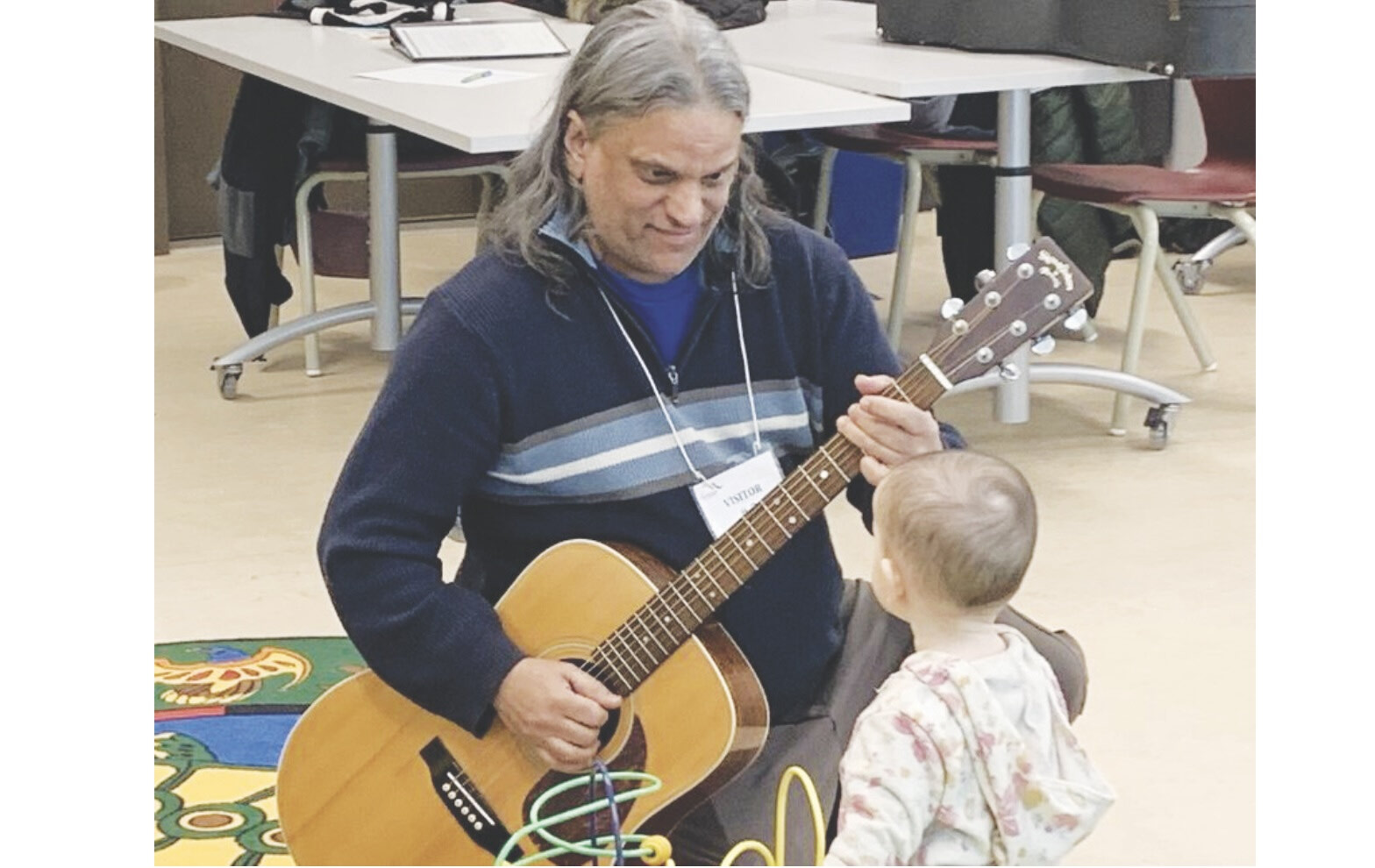
A 2019 report by Aylmer’s Connexions Resource Centre found that English-speaking children under 5 in the Outaouais were more likely than their French-speaking peers to grow up in low-income and single-parent homes, start kindergarten already behind in their development and lack access to services and activities in English. Photo: Courtesy of Connexions
For the youngest English speakers in the Outaouais, the gaps open early
Tashi Farmilo
English-speaking children under 5 in the Outaouais were more likely than their French-speaking neighbours to grow up with less money and a single parent. They were more likely to start kindergarten already behind in their development, and their families often struggled to find health information, care and activities in English. Those are the findings of a regional portrait that Connexions Resource Centre, a community organization based in Aylmer, published in November 2019 to guide its services for young families.
The study, Who Are Our 0-5 Year Olds?, starts from a simple idea: a child does not develop alone. Parents, neighbourhoods, schools and services all shape how a child grows, and those influences can push development forward or hold it back. The report argues that minority communities do not always get the same services or the same information as the majority, and that the shortfall can affect their health. In its view, strengthening the region’s English-speaking community has to start with its youngest members.
Researcher Mylène Dault wrote the report, and the CISSS de l’Outaouais, the regional health authority, paid for it. It brings together 2016 Census data, Quebec’s 2017 assessment of kindergarten children and an online survey of 417 English-speaking families carried out in 2019.
The census counted 3,235 children under 5 in the region whose mother tongue was English. Almost two-thirds of them lived in the city of Gatineau, yet even there they were only about one preschooler in eight, scattered from Aylmer through Hull to Buckingham. The report cautions that being so few can leave families isolated. The Pontiac is the exception. English is the mother tongue of 53.4 per cent of its children under 5, the only part of the Outaouais where they are the majority.
The family finances are where the differences show most clearly. Among households raising a child of 5 or younger, 12.2 per cent of English-speaking families were low-income, compared with 7.3 per cent of French-speaking families. Their average income was about $12,000 a year lower. Among English-speaking parents who answered the census, the unemployment rate was 10.1 per cent, more than two and a half times the rate among French speakers. Just over one English-speaking family in five had a single parent at its head, and in more than four out of five of those families it was the mother. That rate was higher than among French-speaking families in the region and well above the 16.8 per cent recorded across Quebec.
English-speaking parents were also less likely to hold a university degree, and more likely to have stopped at a high school or college diploma. Their homes needed more repairs, minor and major, than those of French-speaking or bilingual families. The report treats these findings as more than background. Education, income and family structure, it argues, all bear on a young child’s health and development.
Those regional averages hide sharp contrasts. In the MRC des Collines-de-l’Outaouais, which includes Chelsea and La Pêche, English-speaking families with young children earned an average of more than $115,000 a year, and barely 4 per cent were low-income. Farther up the Gatineau River, in the Vallée-de-la-Gatineau, about 145 such families earned an average of less than $44,000. Nearly a quarter of them were low-income, and half were single-parent households. In the city of Gatineau, 14.6 per cent of English-speaking families with young children were low-income, compared with 8.8 per cent of their French-speaking neighbours.
The kindergarten findings are the most striking. Quebec’s survey asks teachers to rate each child in five areas: physical health and well-being, social skills, emotional maturity, language and thinking, and communication and general knowledge. A child is considered vulnerable in an area when their score falls in the bottom 10 per cent provincially. The Outaouais was the only region of Quebec where children were vulnerable more often than the provincial average in all five areas.
Among the region’s English-speaking kindergartners, 42.9 per cent were vulnerable in at least one area, compared with 36.8 per cent of English-speaking kindergartners across the province. The gaps with French-speaking classmates were widest in physical health and well-being, which covers motor skills, nutrition, hygiene and arriving at school rested, and in the ability to communicate and be understood. In both areas, English-speaking children were roughly twice as likely to be vulnerable. In the Pontiac, more than half of English-speaking children were vulnerable in at least one area when they started school.
The parents’ survey shows what those gaps look like in daily life. Nearly 70 per cent of respondents said they ask to be served in English when they deal with health or social services, but more than half said they did not have enough information in English about what was available. About two-thirds had a family doctor. Nearly three in four had left the Outaouais for care, and almost all of them crossed the river to Ottawa.
Roughly two-thirds of the children attended daycare. A third of those were in English-only settings, slightly more were in bilingual ones, and about a quarter spent their days in French.
At home, the findings were mixed. Nearly two-thirds of parents said they read their child a story every day. The report counts that as one of the most valuable habits a family can keep. It cites Quebec research showing that simply leafing through a book with a child around age 2 shows up in their school results at 15, and that early literacy affects whether children stay in school.
Most families ate home-cooked meals on most days, about half of the children helped prepare them and nine in ten ate fruits and vegetables at most meals. Screen time was another matter. Canadian guidelines call for less than an hour a day for children 4 and under, and almost none before their first birthday. Yet about a third of the surveyed children under 5 spent more than an hour a day in front of a tablet or television.
Finding activities in English was unreliable. About a third of parents usually succeeded, and more than a quarter rarely or never did. When activities were available, children took part. Nearly half played a sport, more than a third went to playgroups and almost as many joined library programs. Parents said they most wanted places where their children could play with others and learn to manage their emotions. Two-thirds wanted a clearer picture of the help already available to them, and nearly as many said they wished they had more time to look after themselves.
The report notes that its survey is less reliable than census data. Most responses came from Gatineau and the relatively affluent Collines, so the families who are struggling most may be underrepresented. Its authors recommend a separate survey aimed at those families.
Connexions runs a playgroup for English-speaking parents of young children at Cégep Heritage College in Hull. It also lends kits of games, children’s books and speech and language materials from its Aylmer office and from four partner locations in the Collines.
The report’s recommendations go further. They call for an advisory committee that would bring the Western Québec School Board, the regional health authority and parents together around English-speaking preschoolers. They also call for more services and information in English, a focused effort on physical health and communication, and closer support for parents as their children start school. A further recommendation is that the most vulnerable families be at the centre of the work, not on its margins.
The report’s conclusion comes down to timing and community. Acting early, and acting together, is widely recognized as key to a child’s development, and growing up in a minority language adds a challenge that services have to account for. Whatever families and communities do for children in their first years has lasting effects: on how well they do at school, on whether they stay in school and on their physical and mental health. The report ends with an African proverb that sums up its argument: “It takes a village to raise a child.”