
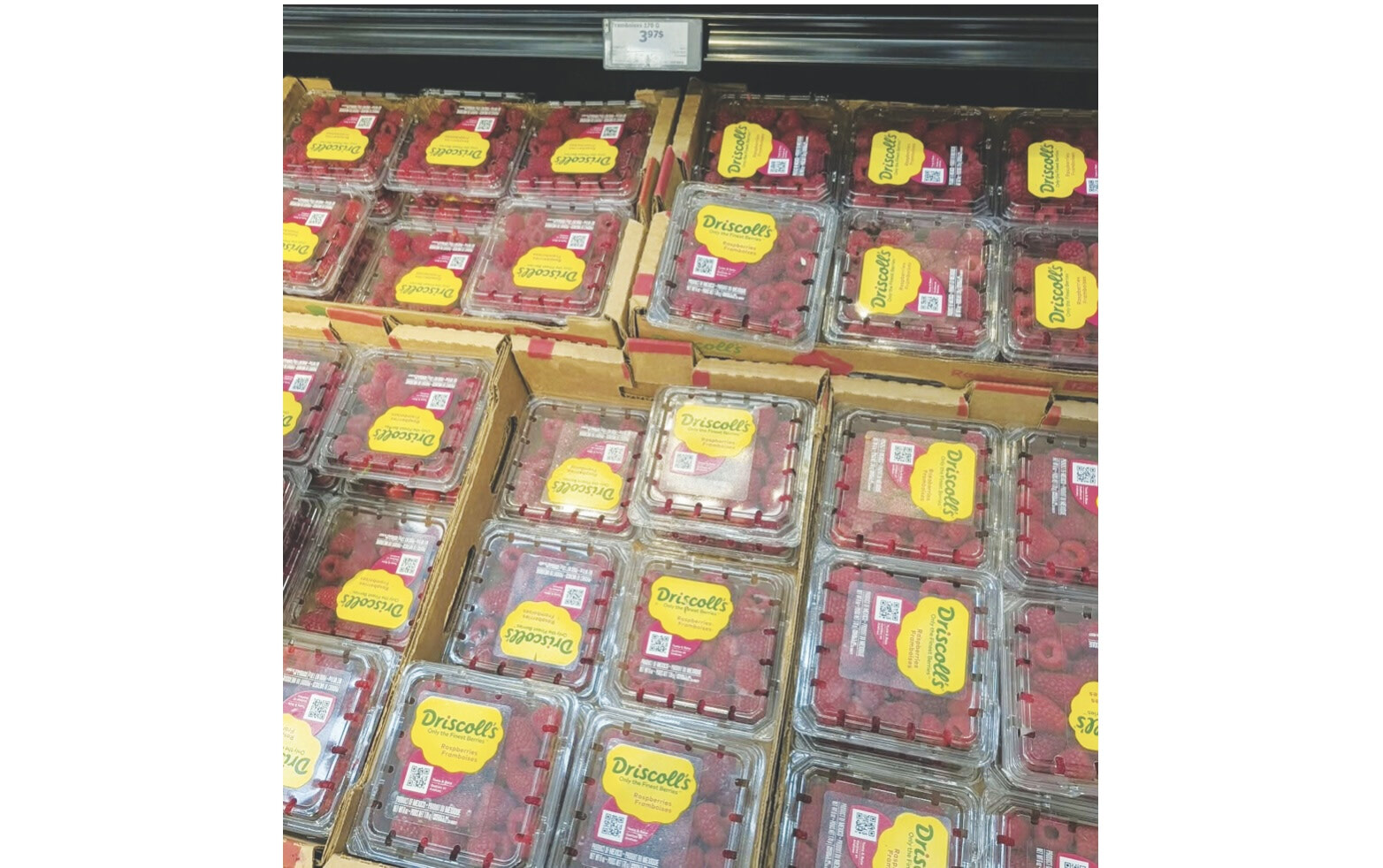
Driscoll’s berries at the centre of a controversy over pesticide residues. Photo: Petar Seslija
Driscoll’s defends its practices following allegations of pesticides in its berries
Petar Seslija
The controversy surrounding Driscoll’s brand berries took a new turn in November, as the U.S.-based company contested allegations that pesticide residues exceeded Canadian limits. The case, which is also the subject of a class-action lawsuit in Quebec, raises questions about corporate transparency and the oversight mechanisms for food sold in the country.
In a statement reported on November 3 by the industry publication Produce Market Guide, Driscoll’s asserts that it maintains control, analysis, and monitoring programs designed to ensure its products comply with the requirements of the markets where it operates, including Canada.
The company maintains that the allegations are based primarily on statements made by a former employee and that it intends to present its evidence during the legal proceedings. It also believes that the alleged violations should be assessed based on their scope and the actual health risks involved.
The case stems in part from revelations by David Harada, Driscoll’s former head of food safety and regulatory compliance for the U.S. and Canadian markets.
In a lawsuit filed in California in June 2026, he alleges that changes to the company’s monitoring systems allowed for the shipment to Canada of 3.37 million trays of berries containing pesticide levels exceeding authorized limits between 2022 and 2024. He also estimates that these products accounted for approximately half of the company’s Canadian exports during that period.
In Quebec, a motion for certification of a class action was filed on September 28 in Superior Court by the law firm Trudel Johnston & Lespérance. The petition targets Driscoll’s and its Canadian division and seeks to represent individuals who have purchased the brand’s strawberries, raspberries, blackberries, or blueberries in Quebec since January 1, 2022.
The plaintiff, Sibylle Gauthier, alleges, among other things, that the company failed to inform consumers of the alleged presence of residues exceeding regulatory thresholds. She is seeking financial compensation and punitive damages.
The Canadian Food Inspection Agency (CFIA) confirms that it has detected concentrations exceeding Canadian limits for three substances: bifenthrin, iprodione, and captan. However, the agency notes that exceeding a maximum residue limit does not automatically mean that a food poses a health risk or that a recall must be initiated.
According to the CFIA, each situation is assessed by considering the detected concentration, potential risks to consumers, and the distribution of the products. The agency may require importers to take corrective measures, conduct additional testing, or increase monitoring. Health Canada is also involved in assessing health risks.
For consumers, the debate centres on compliance with standards and access to information that enables them to make informed choices.
The class-action lawsuit remains in the court authorization phase, and the allegations against Driscoll’s have not been established in court.