
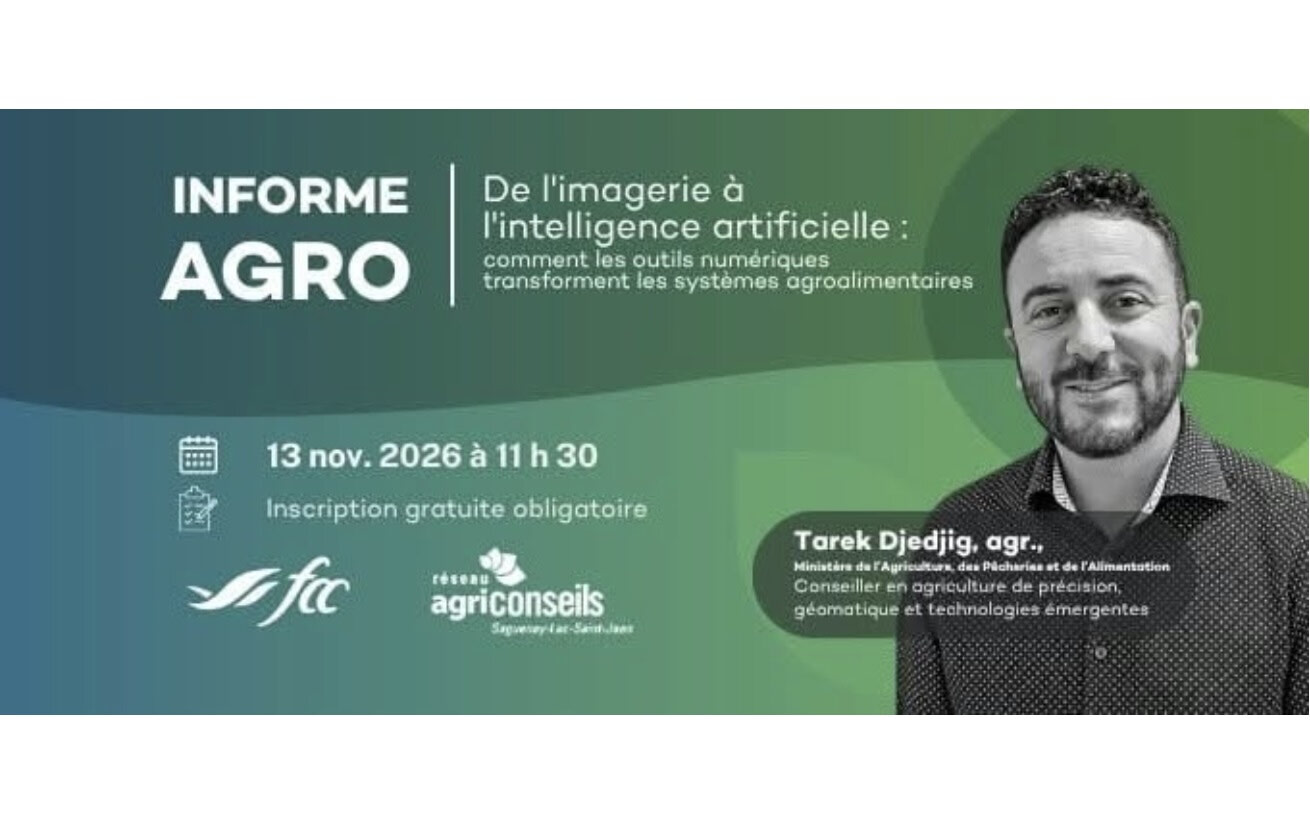
During an online conference, Tarek Djedjig presented the possibilities offered by imaging and artificial intelligence for modernizing agricultural practices. Photo: AgroBoréal "Créneau d’excellence"
Digital Technology Is Transforming Agricultural Practices
Petar Seslija
Digital technology is playing an increasingly significant role in the agricultural sector, offering new opportunities to improve production methods, optimize resources, and address various industry challenges. This was highlighted by Tarek Djedjig, an agronomist and advisor on precision agriculture, geomatics, and emerging technologies at the Quebec Ministry of Agriculture, Fisheries and Food (MAPAQ), during an online conference held on November 13 as part of the "Informe Agro" initiative.
The session, titled "Drones, Connected Devices, Artificial Intelligence… What Is the Potential for Agricultural and Agri-Food Businesses?", explored various digital applications within the agricultural sector. Key factors accelerating this transition include labour shortages and the lasting impacts of the COVID-19 pandemic.
At the heart of this transformation are sensors, which collect essential data on crops and production conditions. "Sensors act as the vital link that allows information to be gathered," explained Tarek Djedjig.
He noted that certain soil-based sensors can measure soil tension and temperature, as well as track the movement of nitrates. This information helps producers better understand crop needs and adjust their management practices accordingly. Other devices can be used with livestock or integrated into agricultural machinery to collect data on animal health or operational efficiency.
Imaging technologies also serve as a valuable tool. Thermal cameras, for instance, can assist in irrigation management by identifying temperature variations within crops. Meanwhile, drones and agricultural robots—such as those used for milking—can gather precise information while reducing the need for repetitive manual tasks. However, collecting data is not enough. Digital platforms capable of processing and interpreting that data are also required. Artificial intelligence can help analyze this information and support decision-making.
Despite technological advances, automation does not mean that human expertise can be replaced. Agricultural conditions depend on a variety of factors, which must be interpreted within their specific context. The experience and judgement of an agronomist remain essential.
The conference was organized by the AgroBoréal "Créneau d’excellence" (center of excellence), in collaboration with the Aliments Santé (Healthy Foods), Acéricole (Maple Syrup Industry), and TransformAction (Food Processing) centres.