
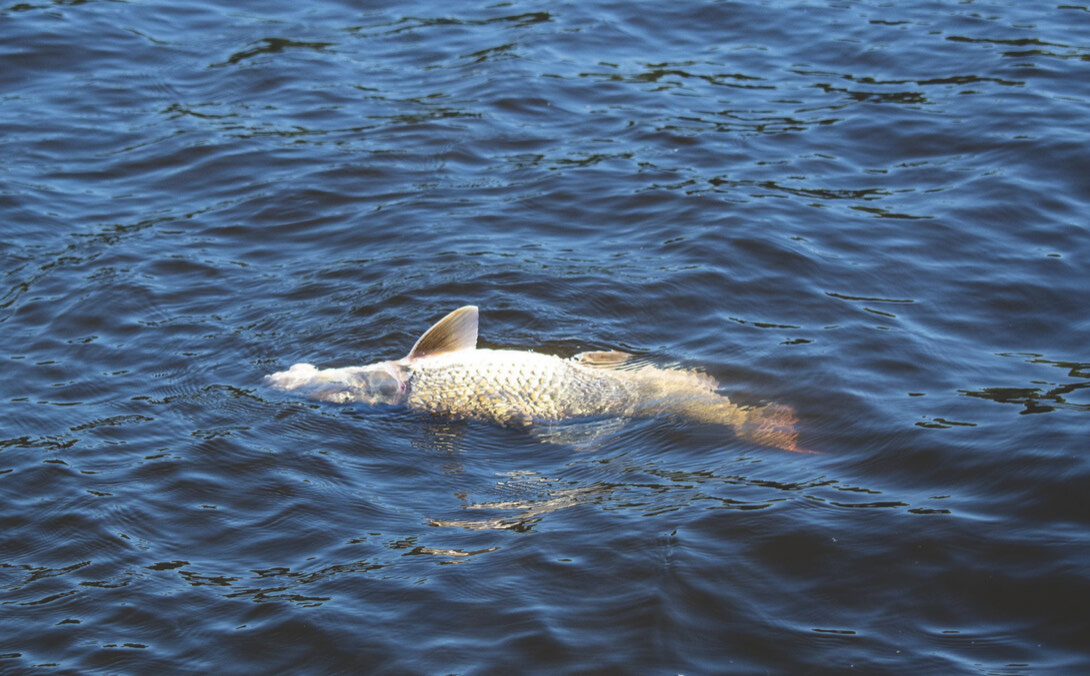
Dead fish in the Ottawa River during the 2019 fishkill incident that occurred at the same time as a chemical spill in the area. Despite the timelines overlapping, no official cause has been confirmed. Photo: Courtesy of Ottawa Riverkeeper
Dead fish explained
Corporation fined $1.35 million for 2019 chemical spill into Rivière du Lièvre
Dead fish in the Ottawa River during the 2019 fishkill incident that occurred at the same time as a chemical spill in the area. Despite the timelines overlapping, no official cause has been confirmed. Photo: Courtesy of Ottawa Riverkeeper
Superior General Partner Inc. has been fined $1,350,000 by the provincial court after the company pleaded guilty to 12 counts of dumping sodium chlorite into the nearby river, Rivière du Lièvre in 2019. The company owned and operated ERCO Mondial, a chemical plant in Gatineau. The plant’s technical and environmental director at the time, Jean-François Roux, has been fined $15,000. Due to the infractions, Superior General Partner Inc. has been added to the Environmental Offenders Registry.
The sum of the fines will go to Canada’s Environmental Damages Fund, which uses money from fines, penalties, and court orders for projects that repair or protect the environment. The Fund will invest in the area where the offence took place.
According to Environment and Climate Change Canada (ECCC), the offences, which took place between June 17 and July 19, 2019, are a violation of the Fisheries Act. The substance got into the river due to equipment failure.
Sodium chlorite is very harmful to fish and other organisms in Rivière du Lièvre, which connects to the Ottawa River. The river is home to a variety of fish species, such as smallmouth bass, brook trout, walleye, and muskellunge.
According to the Ottawa Riverkeeper, the offences occurred while a large fish kill was reported, with thousands of dead fish washing up on the shores along the Ottawa River. The fish kills happened near the connection to Rivière du Lièvre and affected both the Quebec and Ontario sides of the river. At the time they investigated, the ECCC could not link the two events, despite their overlapping timelines.
"In environmental law, it can be very challenging to trace an impact on a body of water back to a single source,” said Laura Reinsborough, CEO of Ottawa Riverkeeper. “So, it is rare that through the Fisheries Act there would be a direct cause or direct link that can be confirmed. I'm not surprised that in this ruling, they could not make that link."
Reinsborough said that the fines are the best conclusion for the case. The Riverkeeper also highlighted the importance of a 13th charge that was laid against the company for failing to immediately report the incidents.
The true cause of the 2019 fishkill remains a mystery for now. Not long after the fishkill occurred, the Quebec Government asserted that the incident occurred due to a local hydro dam. The Ottawa Riverkeeper denied access to the study that led the government to this conclusion. Reinsborough said that they are hoping for more concrete answers, but the Fisheries Act being enforced is good news for the river.
"Going forward, I hope governments can work together if something like this happens again," said the Riverkeeper. "I also encourage the population to hold all levels of government accountable to preserve the health of the river."