
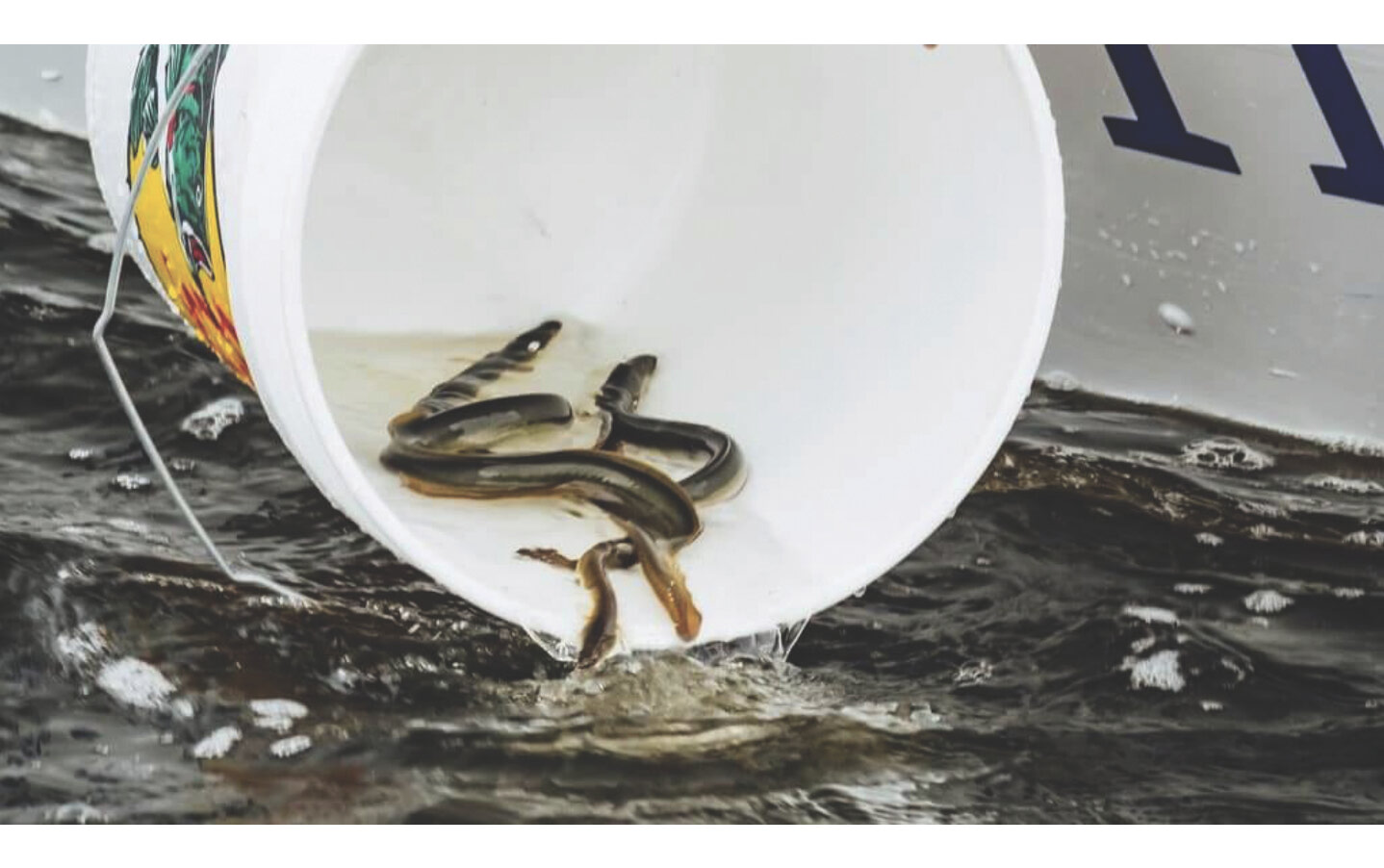
Four species in the Ottawa River watershed are at risk of disappearing, the American eel chief among them, and the Committee on the Status of Endangered Wildlife in Canada says shrinking budgets are leaving it unable to keep pace with the losses. Photo: Courtesy of the Ottawa Riverkeeper
Dams, defunding and a disappearing eel
Tashi Farmilo
The Ottawa River once held so many eels that fisheries scientists classified them as the dominant species in the water. Today, 99 per cent of them are gone, and the federal committee responsible for tracking that kind of collapse is running out of room to do its job.
The Committee on the Status of Endangered Wildlife in Canada, known as COSEWIC, has spent nearly five decades assigning scientific designations to species in peril. Based in Gatineau, it is an independent advisory body of roughly 34 voting members drawn from universities, wildlife agencies, and research organizations, who meet twice a year to assess species and produce formal status reports. Their designations, ranging from "special concern" through "threatened" and "endangered" to "extirpated" and "extinct," represent the most rigorous national accounting of what Canada is losing. The Ottawa River watershed alone is home to four species that have earned the committee's concern: the American eel, the lake sturgeon, the hickorynut mussel, and the spotted turtle.
The eel's story is the most dramatic, and the clearest in its cause. Born in the Sargasso Sea near the Bahamas, young eels drift on ocean currents to the Atlantic coast before swimming upstream into freshwater rivers, where they may spend 25 years maturing. The eels of the Ottawa are all female, and they grow larger than American eels found anywhere else. The Anishinabeg Algonquin had relied on them as a food source for at least 4,000 years. They are nearly gone.
The 19 dams along the Ottawa River bear much of the responsibility. They block young eels trying to reach the river from the ocean, and their turbines kill large numbers of adults on the return journey downstream. Carillon, the first dam eels encounter after leaving the St. Lawrence River, sits roughly 100 kilometres downstream from Ottawa, spans 830 metres, and generates enough power for roughly 150,000 households. It has no eel ladder.
Ottawa Riverkeeper has spent years pressing Hydro-Québec to include one in the facility's $750-million renovation, a project that began in 2020 and will unfold over 16 years. The technology is neither new nor experimental: two ladders at another Hydro-Québec facility on the St. Lawrence have allowed more than 700,000 eels to pass upstream since 2002. The Algonquin Anishinabeg Nation Tribal Council has formally requested a ladder at Carillon as a matter of ecological reparation. Hydro-Québec has pointed to ongoing research without committing to construction.
COSEWIC notes that recovery efforts for the eel involve a 50 per cent reduction in human-caused mortality compared to late 1990s levels, achieved through improved fish passage at dams and reduced fishing pressure, with a long-term goal of restoring abundance to mid-1980s levels. Reaching that goal requires ongoing negotiation among the Ontario and Quebec governments, Fisheries and Oceans Canada, Indigenous groups, commercial fishers, and hydroelectric operators.
The situation of the hickorynut mussel and the lake sturgeon illustrates a different problem: the ecology of dependency. The mussel cannot complete its life cycle without a host fish, and the lake sturgeon is among its most important ones. Both species have been assessed as at risk. Their fates are intertwined in ways that recovery plans focused on individual species can struggle to address.
The spotted turtle, small and easily overlooked in the watershed's wetlands, carries its own urgency. COSEWIC designated it endangered in 2004 and reaffirmed that status a decade later, citing its late maturity, low reproductive output, and fragmented, isolated subpopulations. Road mortality, collection for the pet trade, and wetland loss are its primary threats.
Against this backdrop, COSEWIC itself is under strain. The committee's most recent annual report acknowledged that reduced federal funding has caused a drop in the number of species assessed each year and a growing backlog of cases awaiting review, concerns that were independently confirmed by the Auditor General in 2024. The number of species the committee is resourced to assess annually has fallen considerably in recent years, and the backlog is expected to grow substantially by the end of the decade.
A COSEWIC designation does not, on its own, protect anything. A species must still be formally listed under the Species at Risk Act before any legal protections apply, a decision that belongs to cabinet and one that has sometimes taken years or never come at all. The American eel, assessed as threatened by COSEWIC more than a decade ago, remains unlisted under the federal act. The renovation of the dam most responsible for its collapse in the Ottawa River proceeds without a ladder.