
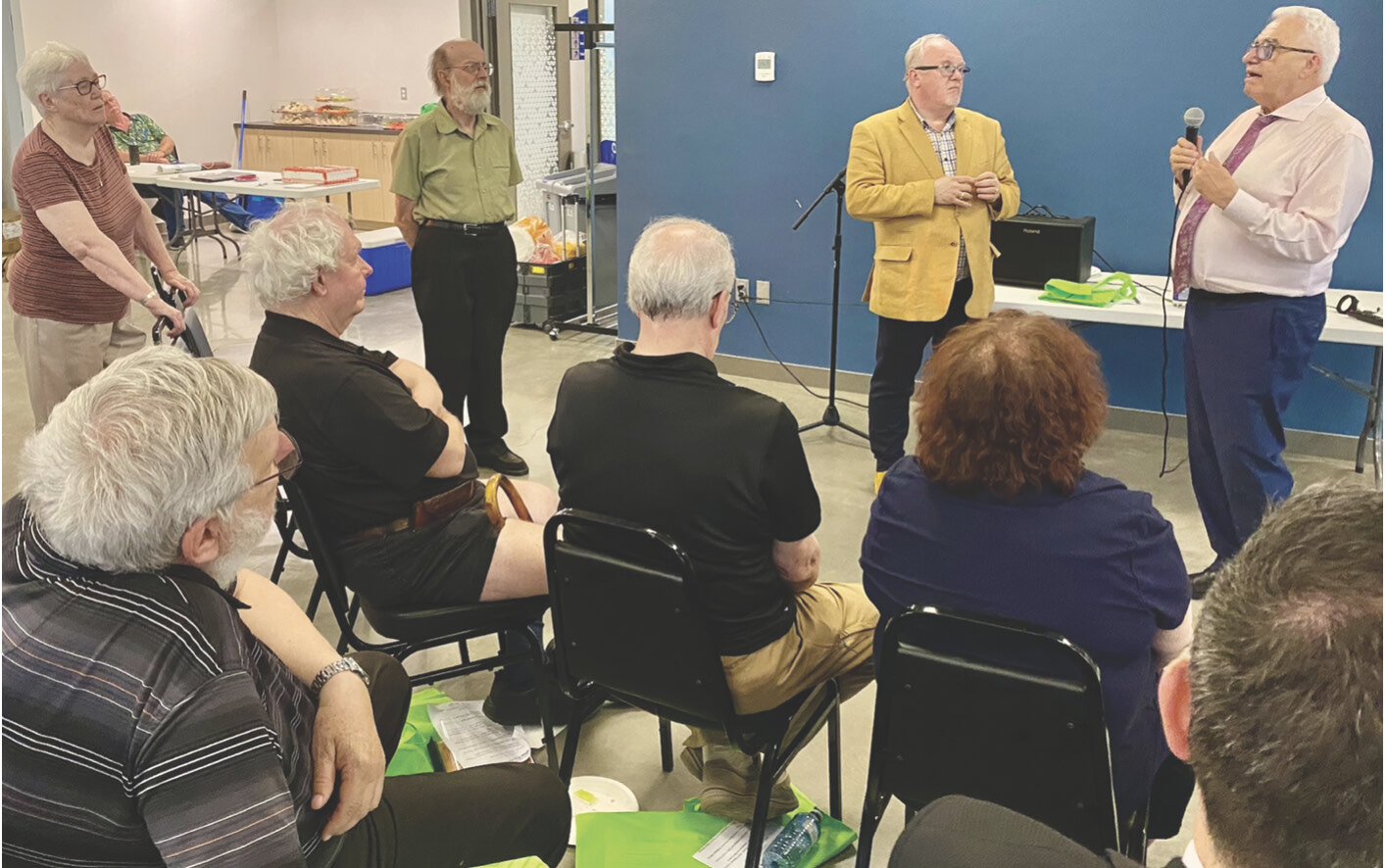
(From left) Judith O’Rourke addresses Commissioner Raymond Théberge during a 2024 public question period (O’Rourke is a Regional Association of West Quebecers (RAWQ) board member); RAWQ president David Gillespie; Charles Taker, Commissioner’s representative for Quebec and Nunavut; Commissioner of Official Languages for Canada, Raymond Théberge. Lily Ryan
Commissioner Théberge highlights progress on Official Languages in Canada, urges action on language plan
Tashi Farmilo
Commissioner of Official Languages Raymond Théberge released his final community-focused report on November 25 in Dieppe, New Brunswick, offering a midterm review of Canada’s current five-year plan to support English and French minority-language communities. The report, Taking Action for Strong and Resilient Communities, evaluates how well the federal government’s $4.1 billion Action Plan for Official Languages 2023–2028 is being carried out.
While the Commissioner noted improvements in areas like immigration, health care and employment services, he warned that chronic delays, complex funding rules and poor coordination continue to limit how well communities benefit from federal support.
The Commissioner of Official Languages is an independent officer of Parliament who ensures that federal institutions follow the Official Languages Act. This law guarantees Canadians the right to receive federal services in either English or French, no matter where they live. The Commissioner’s office also investigates complaints, conducts audits and reports to Parliament. These activities help make sure that language rights are respected in daily life, especially in places where one official language is in the minority.
Théberge’s report is based on meetings and interviews held throughout 2025 with federal departments and community groups. He said that, while there is clear federal commitment, many programs fall short in practice. Community organizations, particularly smaller ones, often face funding that arrives late, rules that are difficult to navigate and little guidance on how to apply. Many have had to delay or cancel projects, run deficits or reduce services because they cannot rely on timely support.
At the press conference, Théberge also spoke about the state of local newspapers in minority-language communities, describing them as essential to civic life. He said these outlets help keep people informed, connected and engaged in public life. Without targeted support, many are at risk of shutting down. Losing them would not only limit access to information but also weaken local identity and democracy.
The report also draws attention to English-speaking communities in Quebec, especially those near the Ontario border. These communities often struggle to access federal support because of provincial regulations. Under Quebec’s Bill M-30, community organisations that receive most of their funding from the province must get provincial approval before signing agreements with the federal government. Théberge said this has caused major delays in rolling out programs intended for English-speaking Quebecers. He urged the federal government to work more closely with provinces to ensure that funding reaches the communities it is meant to support. “It’s one thing to allocate funding,” he said. “It’s another to ensure it reaches the people it’s meant to serve.”
With Parliament preparing to appoint a new Commissioner and planning already underway for the next phase beyond 2028, the report serves as both a progress report and a caution. For communities like Aylmer, where both French and English cultures shape daily life, the Commissioner’s work is a reminder that language rights are not self-sustaining. They require active support from all levels of government.
As his term nears its end, Théberge thanked those working in the field and urged continued vigilance. “Resilience cannot be expected only from communities,” he said. “It must be matched by sustained, thoughtful action from institutions.”